The Korean Times story reads "Turkey Day comes to Korea". No, not really. I'm only dreaming. Although I think they should have because it makes for a great story! But yet again, my story, this alternative narrative I’m a part of, the one that characterizes and drives my home culture during the late fall months, goes unnoticed and untold by most people.
This Thanksgiving I found myself living in a clash of cultures. Inside of me lives this alternative narrative of Thanksgiving. I call it alternative because it is very “other” and exists outside of the common Korean narrative for late November.
There are expectations of where the Thanksgiving plot should take me. It should at least take me to a meal where I shamefully gorge myself on turkey, stuffing, cranberry sauce, green bean casserole and pumpkin pie. More so, it should take me to a gathering of friends and/or family where we "do" community. It should take me to a time of story telling; this is remembering times past and looking forward to the future. It should take me to a time of reflective thankfulness.
Yet the climax of the story, the meal, isn't everything. Often the cultural movement to the “event” is just as much fun and meaningful as the event itself. Admittedly, I never realized this until I lived outside my own culture.
The great build up towards the “event” includes the commercial overload which I admittedly look down upon yet participate in when I'm "State-side". Here I miss the commercialism. In Korea there are no signs: no commercials telling the Thanksgiving story, no talking turkey's with pilgrim hats, no adds for stovetop or cranberry sauce, no stores filled with pumpkin pies and other delights, and no Thanksgiving T.V. specials.
Anticipation and preparation define the movement toward Thanksgiving. Yet in a culture that lives from a different narrative there is communal anticipation and preparation. There is no chatter at the water cooler about where you are going for Thanksgiving, no asking the boss if you can take an early leave on Wednesday to travel, no skipping class, no making flight arrangements to visit family, no telling of what you did last year to co-workers who'd rather tell you their own stories, no complaining about the coming family gathering that has "issues" and no churches calling for food basket donations.
I'm even compelled to qualify what I mean by "Thanksgiving". It isn't Korean Thanksgiving (Chuseok, which was in early October), and it isn't Canadian Thanksgiving (already passed and also early October). Since I live in an international community it isn't just "Thanksgiving" anymore. It is to be qualified as "American Thanksgiving". Yet even when my Canadian friends hear "American Thanksgiving" they know what I really mean is "USA Thanksgiving". Living in a culture with a different story makes me qualify my own story which in the month of November is "American (USA) Thanksgiving".
So within me expectations teem over with anticipation. Yet in Korea, this foreign culture, the expectations can fall to the ground unmet and unlived. They can hit the ground with a splash of disappointment. My American (USA)Thanksgiving story with all of its expectations clash with "just another day" in Korea. Ordinariness tells the story of late November in Korea. Its narrative speaks of colder weather, falling leaves, bleak landscapes, high stress college entrance exams, and a school year ending. If you look closely, you can see the narrative of Christmas just beginning to be told but Thanksgiving passes without a bat of an eye or the lift of a head.
That is, unless, you create space for it, where the space doesn't exist naturally. It passes without anyone knowing it ever arrived unless intentionality breaths life into it.
So this "American (USA) Thanksgiving, " I became intentional about participating in my alternative November narrative. Some of the singles who work for KNU and live side by side on the same floor decided to do something about the American (USA)Thanksgiving narrative living inside of us. We decided to give it life and participate in it even if we live in culture that does not share or story.
Electrifying excitement filled the air the morning of the event. Finally, we were preparing and anticipating something. Eclectic chairs, couches, desks, coffee tables created a temporary home in our dorm-like hallway. Three turkeys, 4 bowls of mashed potatoes, 3 large pans of stuffing, 1 gigantic fruit salad, and a myriad of other mouthwatering foods later we had “the event”. We had a gathering of 30 people on the Saturday after American (USA) Thanksgiving. What is normally a cold hallway with people passing each other briefly became a place of warm sharing of food and fellowship. We were all astounded by what we created; a living alternative narrative.
It is just this, a living alternative narrative, that people who follow Jesus live out. We participate in a story of a loving, merciful, just God who unites his own story with our story through his son Jesus Christ. We participate in God’s narrative when we follow Jesus Christ. Yet unless we create space for it, it won’t happen. Days and years can pass without anyone knowing it ever existed.
After this American (USA) Thanksgiving I’m aware of how easy it is to expect the Christian narrative—the story of God’s creative love and redemption--to just happen. Yet it doesn't just happen because it is all too "other" from a culture we are immersed in--both American and Korean. I’m teeming with great expectations. Yet, it is easy for my expectations to fall to the ground unmet and unlived. Not because the story doesn’t exist, but because intentionality takes time and space. Like the Thanksgiving Dinner showed intentionality births life.
Knowing that I don’t have to live in Korea to feel a clash of cultures and a clash of narratives, I have questions. What qualifies the Jesus story from the other stories of our culture? What are our expectations for the Jesus narrative? When the story lives out from us, where does it take us? What kind of anticipation and preparation is involved in our movement towards Jesus? What are the signs that let people know the Jesus narrative lives in our culture?
11.22.2006


11.20.2006
Re-Imaginging a Global Gospel
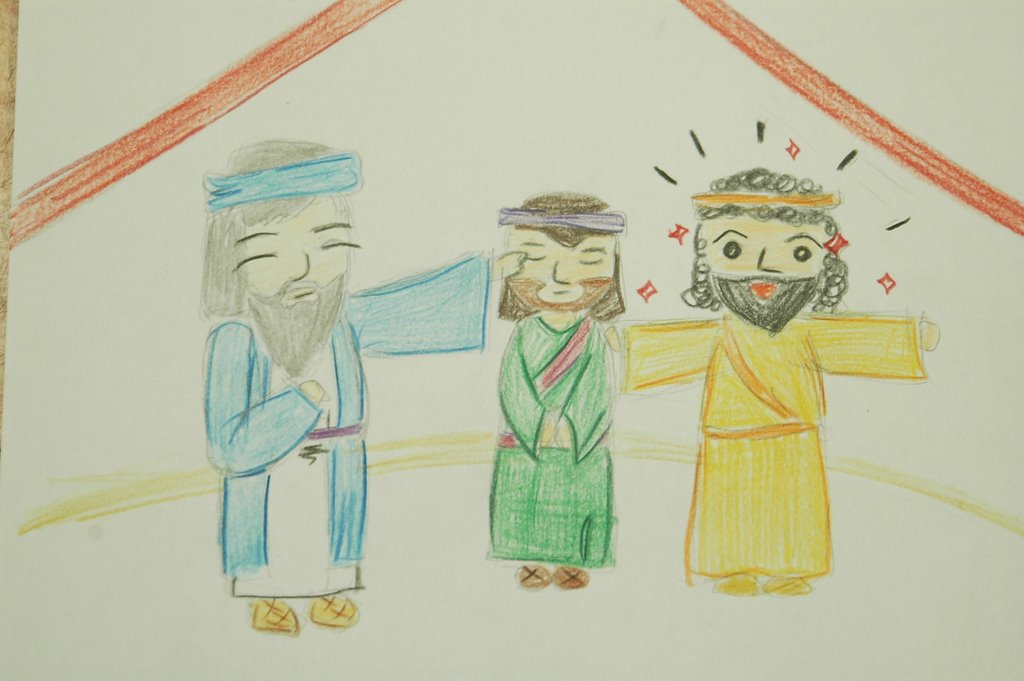
I saw familiar stories of the gospel last week with a whole new perspective. This semester I assigned my students a story from a gospel to memorize. They had the whole semester to learn and practice their passages. It is a difficult task, I know. Their task was first to memorize and second to present in class with creativity. Most students presented drawings, some used body language, some acted, and some wore costumes.
It was their drawings that continue to leave me reevaluating how I read the word. You mean Jesus isn't white? Again I'm reminded by how my story, even God's story which I find myself in, still finds shape by my western and very white culture. When I read and visualize scripture, I see white people. Yes, I know Jesus was from the Middle East so he wasn't white. Yet when I'm honest, in my minds eye, he is white. Yet it goes further, not only is Jesus white, but those he ministers to are also white. In my minds eye, Jesus closest friends are white, his mom and dad are white and if you push me further I even picture God the Gather as a "white God". Why would it be any different! I can let myself of the hook to some degree. However, I realize that this profoundly influences how I participate in and live out of God's story. I've lived out of my home country for more than two years. Yet, my home culture still remains a powerful force. It shapes my imagination and shapes my participation in life.
So the non-white portrayals of Jesus were surprising to me at first. Jesus was Korean in their pictures. (he wasn't even Middle Eastern) The people that Jesus comes into contact with, even his disciples, were not white people in their drawings! They are Korean! I was surprised because their worldview is so differnt from mine. Now that I think about it, I shouldn't be surprised. Of course Jesus is Korean. I am aware, however, that they have the same "problem" that I have. Their worldview is hyper-Korean as mine is hyper-"white". I wonder what would happen if when we read scripture we began to see people of all races as the "blindman", "the woman with a bleeding problem", the "demon possessed" or even "Paul".
I've been thinking this week that there is need for the church to re-imagine a global gospel. No, don't change scripture. Yet, let's look at how limited our understanding of God's participation in the world is when our imagination of scripture is dominated by our own culture. I'm more aware today than ever how important our Christians sisters and brothers around the world are to my own gospel imagination. I need them, those in Asia, Africa, S. America, Europe, to help me imagine the gospel.
What if our Sunday curriculim in the west had a mixture of races represented? What if when we read passages together we talked about who was included in Jesus' ministry? What if when we presented texts to be read in our worship we helped our people re-imagine who the people of today's story are? My students gifted me last week with a challenge. They have unknowingly challenged me to re-imagine a global gospel. Thank you students! Your hard work has paid off more than you'll ever know.
It was their drawings that continue to leave me reevaluating how I read the word. You mean Jesus isn't white? Again I'm reminded by how my story, even God's story which I find myself in, still finds shape by my western and very white culture. When I read and visualize scripture, I see white people. Yes, I know Jesus was from the Middle East so he wasn't white. Yet when I'm honest, in my minds eye, he is white. Yet it goes further, not only is Jesus white, but those he ministers to are also white. In my minds eye, Jesus closest friends are white, his mom and dad are white and if you push me further I even picture God the Gather as a "white God". Why would it be any different! I can let myself of the hook to some degree. However, I realize that this profoundly influences how I participate in and live out of God's story. I've lived out of my home country for more than two years. Yet, my home culture still remains a powerful force. It shapes my imagination and shapes my participation in life.
So the non-white portrayals of Jesus were surprising to me at first. Jesus was Korean in their pictures. (he wasn't even Middle Eastern) The people that Jesus comes into contact with, even his disciples, were not white people in their drawings! They are Korean! I was surprised because their worldview is so differnt from mine. Now that I think about it, I shouldn't be surprised. Of course Jesus is Korean. I am aware, however, that they have the same "problem" that I have. Their worldview is hyper-Korean as mine is hyper-"white". I wonder what would happen if when we read scripture we began to see people of all races as the "blindman", "the woman with a bleeding problem", the "demon possessed" or even "Paul".
I've been thinking this week that there is need for the church to re-imagine a global gospel. No, don't change scripture. Yet, let's look at how limited our understanding of God's participation in the world is when our imagination of scripture is dominated by our own culture. I'm more aware today than ever how important our Christians sisters and brothers around the world are to my own gospel imagination. I need them, those in Asia, Africa, S. America, Europe, to help me imagine the gospel.
What if our Sunday curriculim in the west had a mixture of races represented? What if when we read passages together we talked about who was included in Jesus' ministry? What if when we presented texts to be read in our worship we helped our people re-imagine who the people of today's story are? My students gifted me last week with a challenge. They have unknowingly challenged me to re-imagine a global gospel. Thank you students! Your hard work has paid off more than you'll ever know.
Students Visual for Matthew 9: 27-34

As Jesus went on from there, two blind men followed him, calling out, "Have mercy on us, Son of David!" When he had gone indoors, the blind men came to him, and he asked them, "Do you believe that I am able to do this?" "Yes, Lord", they replied. Matt. 9: 27-28

Students Bible Project
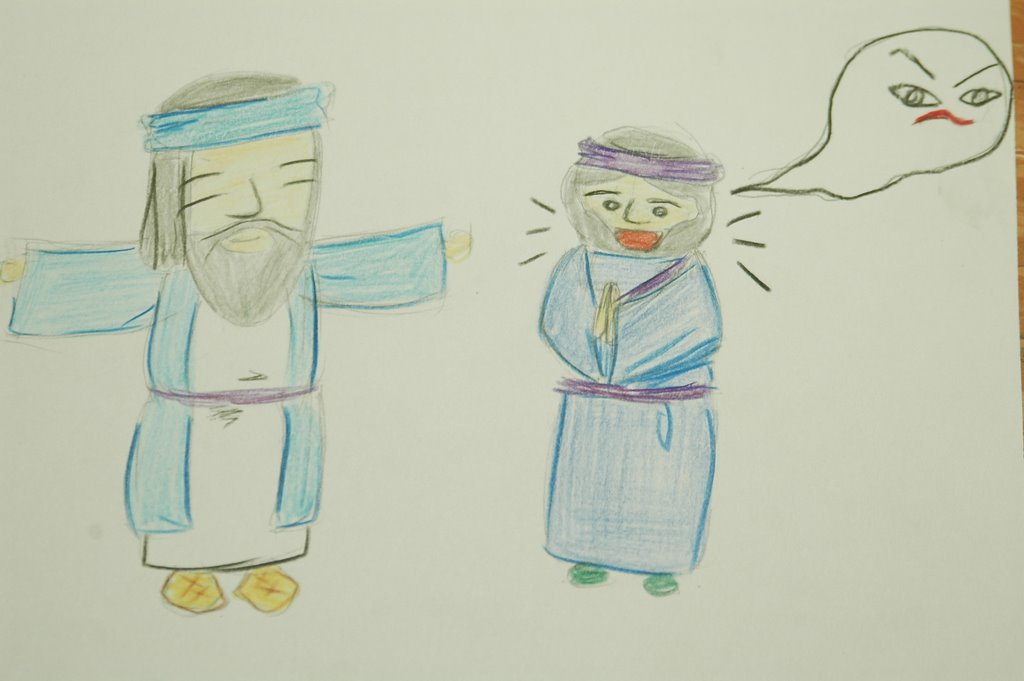 And when the demon was driven out, the man who had been mute spoke. The crowd was amazed and siad, "Nothing like this has ever been seen in Israel." But the Pharisees said, "It is by the prince of demons that he drives out demons." Matt. 9: 33-34
11.15.2006

11.14.2006
"Looking" as God "Looks"
The story of Moses and the burning bush has been on my mind for months now. Tim Keel a pastor of Jacobs Well church pointed out that Moses would never have heard God speaking to him if he wouldn't have given his "attention" to the bush. Moses "looked" at the bush first, and then God spoke to him in the fire. Moses says, "I must turn aside and look at this great sight and see why the bush is not burned up." Moses curiousity lead him to look. In looking he found God. In finding God he heard God. In hearing God he was called. In being called God lead him to free his people from slavery.
As a kid I loved the burning bush story. It is magical. It is mysterious. It is out of this world! As an adult I don't get as excited about the burning bush. Come on! It is silly! It is unbelievable. God never speaks in burning bushes. Does he?
Yet, sometimes I wish God would speak in magical and mysterious ways. I wouldn't even mind if he spoke through silly ways. It sure would be nice if God gave burning bush type experiences today. If he did, then I'd have proof of his presence. I'd know he was real. I'd know there is purpose. I'd know I'm not alone.
Yet after ruminating on Exodus 2: 25- 3 I don't believe Moses got up that morning expecting to find God in a burning bush. I do, however, think he was a man who looked for God in his world. He must have been curious about God and the things of God. He must have been one who paid attention. He noticed. He was aware. It was his attention, his noticing that lead him to see and hear God in the mysterious and yes, even silly, bush. It was Moses disposition that lead him to hear God that day.
But it wasn't just Moses' disposition of being "attentive" or "curious". It was more. Moses knew God. He was God's "man" way before he was "God's man" for setting the slaves free. God was working in and on Moses way before the burning bush. And who is this God that was working in and on Moses? In Exodus 2: 25 it says, "So God looked on the Israelites and was concerned about them." Before Moses ever went out that morning to graze his flock, before Moses looked and noticed this bush that wasn't burning to the ground, God looked and noticed his hurting people.
The God of Moses, the God who Moses lived for, was and is a God who pays attention. The God of Moses was and is aware. The God of Moses is curious. People who follow the God who notices, notice. People who follow the God who looks, look. People who follow the God who pays attention, pay attention. It was Moses' disposition to look because it was God's disposition to look.
So, I wonder, where is God looking today? Because wherever he is "looking" it is there that he is speaking. If I'm a Jesus follower then I need to practice a life of "looking", "noticing", "paying attention" to what God is "looking", "noticing", and "paying attention" to. It is in looking, that I will hear God in today's "burning bushes". I guess if I look where he looks, I'd have proof of his presence. If I look where he looks, I'll know he is real (and so will others). If I notice what he notices, I will know I'm not alone (and so will others). If I pay attention to what he pays attention to, I'll recognize my life has purpose (and so will others).
Today's burning bushes are where God looks! God is looking on a people who need to be set free from slavery for starters! In looking, we'll hear. In hearing, I wouldn't be surprised if he calls. If the God who looks is still concerned for his people,(he is) then in calling, he'll continue to use people like you and me to set his people free. Where God is looking, he is present. Where God is present, he speaks. Where he speaks, he sets free.
As a kid I loved the burning bush story. It is magical. It is mysterious. It is out of this world! As an adult I don't get as excited about the burning bush. Come on! It is silly! It is unbelievable. God never speaks in burning bushes. Does he?
Yet, sometimes I wish God would speak in magical and mysterious ways. I wouldn't even mind if he spoke through silly ways. It sure would be nice if God gave burning bush type experiences today. If he did, then I'd have proof of his presence. I'd know he was real. I'd know there is purpose. I'd know I'm not alone.
Yet after ruminating on Exodus 2: 25- 3 I don't believe Moses got up that morning expecting to find God in a burning bush. I do, however, think he was a man who looked for God in his world. He must have been curious about God and the things of God. He must have been one who paid attention. He noticed. He was aware. It was his attention, his noticing that lead him to see and hear God in the mysterious and yes, even silly, bush. It was Moses disposition that lead him to hear God that day.
But it wasn't just Moses' disposition of being "attentive" or "curious". It was more. Moses knew God. He was God's "man" way before he was "God's man" for setting the slaves free. God was working in and on Moses way before the burning bush. And who is this God that was working in and on Moses? In Exodus 2: 25 it says, "So God looked on the Israelites and was concerned about them." Before Moses ever went out that morning to graze his flock, before Moses looked and noticed this bush that wasn't burning to the ground, God looked and noticed his hurting people.
The God of Moses, the God who Moses lived for, was and is a God who pays attention. The God of Moses was and is aware. The God of Moses is curious. People who follow the God who notices, notice. People who follow the God who looks, look. People who follow the God who pays attention, pay attention. It was Moses' disposition to look because it was God's disposition to look.
So, I wonder, where is God looking today? Because wherever he is "looking" it is there that he is speaking. If I'm a Jesus follower then I need to practice a life of "looking", "noticing", "paying attention" to what God is "looking", "noticing", and "paying attention" to. It is in looking, that I will hear God in today's "burning bushes". I guess if I look where he looks, I'd have proof of his presence. If I look where he looks, I'll know he is real (and so will others). If I notice what he notices, I will know I'm not alone (and so will others). If I pay attention to what he pays attention to, I'll recognize my life has purpose (and so will others).
Today's burning bushes are where God looks! God is looking on a people who need to be set free from slavery for starters! In looking, we'll hear. In hearing, I wouldn't be surprised if he calls. If the God who looks is still concerned for his people,(he is) then in calling, he'll continue to use people like you and me to set his people free. Where God is looking, he is present. Where God is present, he speaks. Where he speaks, he sets free.
11.13.2006
I'm Listening
Korea is a hard place to live. Although I'm aware that the difficulties are not all about Korea but rather they are more just the difficulties of life. Last week was a rough week for me. Yet as I reflect on it, I'm really dumbfounded by how I am hearing God in my life. Hearing God's voice somehow makes a rough week not so bad. It puts the struggle, the questions, the concerns into their right place.
This semester I've thought a lot about how I listen to God. In our English chapels I've preached about listening to God through our whole life experience. I'm beginning to realize just how intentional "listening" has to be. God is speaking, no not audibly, but he is speaking.
He speaks through the beauty of a snow fall on red, orange and yellow fall leaves. He speaks through a neighbor who opens her life up and shares her heart. He speaks through a stranger who opens a door, holds the elevator, and allows me to exit before they enter. He speaks through a student who offers an intentional gift of kindness. He speaks through a friend who is able to live well and love well through her disabled-ness. He speaks through family members who show interest in important matters and want to experience life together. He speaks through church member who offers to give me a ride home from the grocery store so that I don't have to walk with the load of groceries. He speaks through shared meals together with friends. He speaks through conversation about God with a friend who speaks very little English yet works hard to understand. He speaks through a random phone call from a friend. Maybe it wasn't so "random" after all. He speaks through the sunshine and warm respit from an early winter. God is speaking. I'm learning to listen. It isn't as easy as I once thought. It requires my attention, the attention that is often given to so many other less meaningful things and the attention that is often focused on the difficulties, the questions and concerns of daily life.
I'm often not sure what God would want to say to me if I really heard his voice. Yet, in so many moments when it is clear that God is participating in this life together he is communicating his presence, his desire for relationship, his desire to be known and sought after, his love of beauty and goodness, his ability to make ordinary people and things extroardinary. He may not be saying audible words but all those things mean the world to one who is on the journey of following Jesus to wherever he is going here in Korea and beyond.
This semester I've thought a lot about how I listen to God. In our English chapels I've preached about listening to God through our whole life experience. I'm beginning to realize just how intentional "listening" has to be. God is speaking, no not audibly, but he is speaking.
He speaks through the beauty of a snow fall on red, orange and yellow fall leaves. He speaks through a neighbor who opens her life up and shares her heart. He speaks through a stranger who opens a door, holds the elevator, and allows me to exit before they enter. He speaks through a student who offers an intentional gift of kindness. He speaks through a friend who is able to live well and love well through her disabled-ness. He speaks through family members who show interest in important matters and want to experience life together. He speaks through church member who offers to give me a ride home from the grocery store so that I don't have to walk with the load of groceries. He speaks through shared meals together with friends. He speaks through conversation about God with a friend who speaks very little English yet works hard to understand. He speaks through a random phone call from a friend. Maybe it wasn't so "random" after all. He speaks through the sunshine and warm respit from an early winter. God is speaking. I'm learning to listen. It isn't as easy as I once thought. It requires my attention, the attention that is often given to so many other less meaningful things and the attention that is often focused on the difficulties, the questions and concerns of daily life.
I'm often not sure what God would want to say to me if I really heard his voice. Yet, in so many moments when it is clear that God is participating in this life together he is communicating his presence, his desire for relationship, his desire to be known and sought after, his love of beauty and goodness, his ability to make ordinary people and things extroardinary. He may not be saying audible words but all those things mean the world to one who is on the journey of following Jesus to wherever he is going here in Korea and beyond.
11.10.2006
Ability in Disability

Ji Young and I have known each other for two years now. She was in one of my English classes. Ji Young and I are the same age. I tease her that I'm her "elder" (which is important in Korea) because I am 4 days older than her. She always laughs. Ji Young is teaching me about life. Because of her disability, she can not walk and she doesn't have control of her limbs. Her mom is her caretaker. (an amazing woman!) Everything she does (except for thinking) requires the help of another. I can not imagine being so dependent on another person. Today when she came over she was hungry. I helped her eat a snack. I experienced first hand (no pun intended) how dependent she is. She allowed me to feed her. Ji Young's gift to me is her ability to have a disability. In her disability she has the ability to help me to see beyond "what I see". In her disability she has the ability to teach me to listen well. In her disabilty she has the ability to teach patience. Ji Young's English name is "Joy". She is just that--Joy--and she gifts people with joy. Today Ji Young was in charge of the recipe. She told me what to do and I did it. She liked the "power". She doesn't like sweet things, but she liked our oatmeal cookies.
Snow in Fall




 Winter came way too early this year! At least it was beautiful! I've never seen snow on red, orange, yellow, and green leaves.
11.07.2006
Early Snow
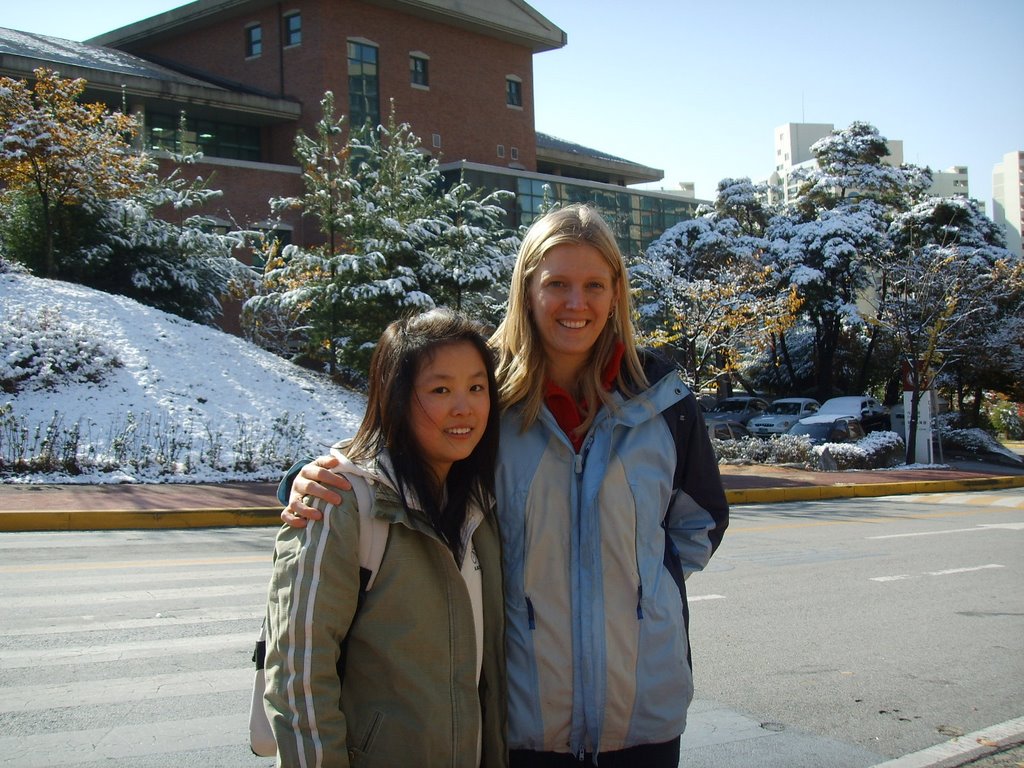
This is Soon and I. Soon is an exchange student from China. She caught me out taking pictures.
Subscribe to:
Posts (Atom)